Turning Waste Into Margin: Why Pre-Portioning Bags Work
Food service operators heading into 2026 face two familiar pressures: volatile ingredient costs and unpredictable demand. Under these conditions, food cost control – once a margin buffer – is now a core survival strategy. One of the simplest, highest-ROI tools available is also one of the most overlooked: portion control through pre-portioning.
Across the U.S. food system, wasted food represents a large and persistent financial drain. According to the U.S. Environmental Protection Agency (EPA), an estimated 66 million tons of wasted food were generated in 2019 across retail, foodservice, and households, making food the largest category of material landfilled nationwide. ¹ A growing body of research also confirms that significant waste originates in foodservice operations due to overproduction, improper portioning, and inconsistent execution. ²
A widely cited national study led by the nonprofit ReFED (Rethink Foodwaste through Economics and Data) places the annual economic cost of wasted food in the United States at approximately $473 billion, including the value of wasted ingredients, labor, energy, and disposal. ³ Because restaurants operate on the thinnest margins in the system, any preventable loss (especially from portion drift) compounds quickly at scale.
Pre-portioning offers a low-tech, high-impact way to address those avoidable losses.
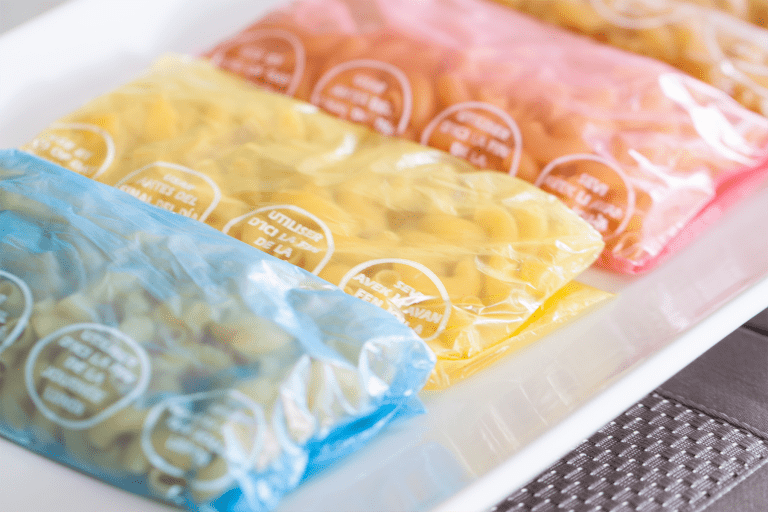
Handgards continues to support operators with tools that strengthen consistency, reduce controllable costs, and simplify back-of-house execution. TuffGards Pre-Portioning Bags do just that – providing an easy, reliable way to bring portion discipline upstream and protect margin in any operating environment.
Why Pre-Portioning Works Financially
- It Eliminates Portion Drift
- Pre-portioning ensures that every 4 oz protein portion, every 2 oz sauce unit, and every garnishing component carries a predictable cost. This closes the costly gap between “theoretical” and “actual” food cost.
- It Supports SKU Control and Cross-Utilization
- Standardized portions support accurate recipe costing and make usage patterns easier to track — a critical advantage as 2026 menus rely more heavily on cross-utilized ingredients.
- It Reduces Waste Before It Happens
- Research consistently finds that preventing food waste upstream delivers the greatest financial return. A review of waste-reduction programs found that interventions focused on prevention generated an average of $14 in savings for every $1 invested. ⁴ Pre-portioning is a textbook prevention strategy.
- It Improves Labor Efficiency
- Portioning during prep removes cognitive load from line staff during service. This reduces over-portioning, speeds execution, and lowers training demands in a tight labor market.
Why Pre-Portioning Matters to the P&L
Operators universally agree that portion control is important. The disconnect lies in execution. Under pressure, line cooks may default to “safe” over-portioning, especially on high-visibility items like proteins, cheese, and sauces.
Pre-portioning shifts the decision upstream:
- Cost becomes a unit, not a guess.
Each bag represents a fixed, known cost tied directly to menu engineering and forecasting. - Labor is repositioned, not added.
Easily trained prep staff portion accurately during slower periods, reducing variability on the line. - Variance across shifts and locations decreases.
Every plate begins from the same baseline, improving multi-unit consistency.
For operators, pre-portioning is a rare operational lever: low-cost, simple to implement, and directly tied to controllable food cost improvement.
Conclusion: Portion Control as Margin Protection
In a business defined by narrow margins, input cost pressure, and unpredictable demand, the value of portion control cannot be overstated. Pre-portioning brings portion discipline upstream, increases predictability, reduces waste, and protects margins with minimal capital expenditure.
For 2026, operators looking for a high-ROI approach to food cost control, one that scales from independent units to multi-unit operations, would be wise to make pre-portioning a core part of their back-of-house standard operating procedure with Tuffgards pre-portioning bags.
References
¹ U.S. Environmental Protection Agency. (2023). Food: Material-specific data. https://www.epa.gov/facts-and-figures-about-materials-waste-and-recycling/food-material-specific-data
² Kaman, G.S., Bozkurt, İ., Bölükbaş, R., Özhasar, Y., Demirci, B., & İrfan, Y. (2024). The Strategy Food Waste in Restaurants: A Systematic Literature Review. Trends in Food Science & Technology.
³ ReFED. (2023). Insights Engine: Food Waste Estimates & Economic Impact. https://refed.org
⁴ World Resources Institute. (2017). Reducing food loss and waste: Setting a global action agenda. https://www.wri.org/research/reducing-food-loss-and-waste-setting-global-action-agenda