
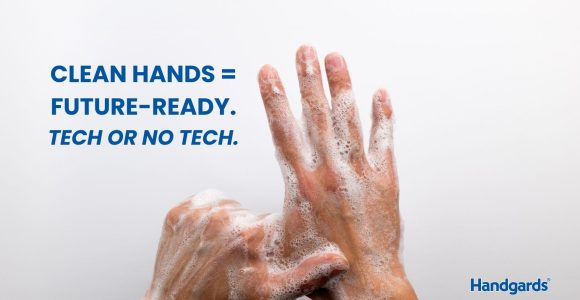
Future-Proofing Food Safety:
Why Proper Handwashing Still Outperforms Technology
The back-of-house world is changing, and quickly. Smart sensors, automated checklists, and AI-driven monitoring tools are becoming standard and changing workflows. One truth remains unchanged, however: the most powerful food-safety tool is still a pair of clean, properly washed human hands.
Even with the rise of automation, the fundamentals continue to matter most. The National Foundation for Infectious Diseases (NFID) reports that roughly 80% of infectious diseases are spread by dirty hands. In foodservice, a recent study tracking nearly 187,000 hand-hygiene events in U.S. quick-service and casual-dining kitchens found significant gaps during critical handwashing moments. At the same time, modern hygiene studies consistently show that soap-and-water washing reduces diarrheal and infection risk across multiple settings.
Together, the evidence is clear: thorough handwashing remains the strongest frontline defense in foodservice, a point reinforced by the National Restaurant Association’s ServSafe® program, which identifies handwashing as the #1 step in preventing cross-contamination.
Technology can support food safety – but properly and regularly cleaned hands are what truly upholds it. At Handgards, we believe this foundation remains essential to every safe, efficient kitchen.
Technology Helps, But It Won’t Replace Clean Hands
Foodservice technology has advanced rapidly, improving monitoring, consistency, and recordkeeping. But it still can’t prevent the contamination risks that happen in seconds:
- Raw-to-ready cross-contamination
- Transfer of viruses and bacteria
- Touchpoints between surfaces, equipment, and staff
A device can remind someone to wash, but it cannot wash thoroughly for them. This is why operators continue to rely on strong hygiene practices supported by clear, consistent training.
The Science Still Favors Soap
While technological innovation brings new efficiencies, soap and water still do what no device can:
- Soap breaks down oils that trap pathogens
- Scrubbing physically dislodges contaminants
- Micelles lift and trap germs
- Water rinses them away
This mechanical action of friction + chemistry is still unmatched and remains the most effective frontline defense in kitchens.
Technology Won’t Replace Accountability
Even with digital systems in place, the success of any food-safety program relies on people:
- Employee awareness
- Personal responsibility
- Leaders modeling correct behavior
- A kitchen culture where handwashing is universal
You can automate reminders, but you can’t automate responsibility. High-performing kitchens must rely on strong habits, not just strong equipment.
Proper Handwashing (Simple, Effective Steps)
- Wet hands
- Apply soap
- Scrub for 20 seconds: palms, backs, between fingers, under nails
- Rinse thoroughly
- Dry completely
Five steps. Twenty seconds. Proven effective.
Future-Proof by Strengthening the Basics
As operators plan for the next decade of innovation, the smartest strategy is blending new technology with timeless SOPs. Proper handwashing continues to support:
- Stronger inspection performance
- Reduced cross-contamination
- More consistent guest experiences
- Lower foodborne illness risks
- A more confident workforce
Innovation will continue to reshape the kitchen, but hygiene fundamentals will always define its success.
The Most Future-Ready Move Is Also the Most Simple
For operators wanting to reduce risk and protect their business, the path is clear:
Invest in the basics. Reinforce them relentlessly. Lead by example.
No matter how advanced the kitchen becomes, proper handwashing will always be the simplest and most reliable way to keep guests, employees, and operations safe.
Handgards Handwashing Resources
Reinforce the basics with clear, consistent reminders. Download our free Handgards Handwashing Technique & Training PDFs to post in your kitchen below. Clear visuals reinforce proper handwashing and support strong hygiene habits across every shift.
Handgards Must Wash Hands Poster
Step-by-Step Handwashing Guide
Sources
Arbogast, J. (n.d.). Hand Hygiene 101. National Foundation for Infectious Diseases. https://www.nfid.org/hand-hygiene-101
Centers for Disease Control and Prevention. (n.d.). Food Worker Handwashing in Restaurants. https://www.cdc.gov/restaurant-food-safety/php/practices/handwashing.html
Centers for Disease Control and Prevention. (n.d.). Foodborne Germs & Illnesses. https://www.cdc.gov/foodsafety/foodborne-germs.html
Global Handwashing Partnership. (2022). 2022 Hand Hygiene Research Summary. https://globalhandwashing.org/wp-content/uploads/2023/05/HH-2022-Research-Summary_Final.pdf
Journal of Food Protection. (2022). Hand Hygiene Product Use by Food Employees in Casual Dining and Quick-Service Restaurants. https://www.sciencedirect.com/science/article/pii/S0362028X22000060
National Restaurant Association. (n.d.). ServSafe. https://www.servsafe.com
World Health Organization. (2021). World Hand Hygiene Day: Key facts and figures. https://www.who.int/campaigns/world-hand-hygiene-day/2021/key-facts-and-figures